
The short answer
Midsommar is the biggest day in the Swedish year after Christmas, and it is a private one. Midsommarafton, Midsummer's Eve, falls on the Friday between 19 and 25 June, so the date moves every year. People travel out of the cities to a house in the countryside, to relatives, or to a village celebration. Things begin in the early afternoon and run late into a sky that never goes fully dark. A pole called a midsommarstång or majstång is raised, dressed with flowers, and danced around in rings by adults and children together. The food is cold and shared: sill, new potatoes with dill, soured cream, crispbread, strawberries. Guests bring something, and they ask the host what.
There is no venue, no ticket and no programme
Your first Midsommar arrives with the shape of a festival in your head, and that is the wrong shape. Nothing is being staged for you to buy your way into. Midsommarafton is celebrated at somebody's house, in a garden, at a family's summer place, or on the grounds of a village association run by the people who live there. The guest list is a kitchen table and a phone. If nobody has put you on it, the day goes past very close to you and completely without you.
The other half of the surprise is what happens to the city. A lot of people leave, on the Thursday evening or on the Friday morning, heading for a house in the countryside, for relatives, or for whichever friend has the garden. The roads out are busy. What stays behind is quieter than an ordinary Friday: fewer people in the street, shops shut or closing early, restaurants on short hours. That is worth knowing on the Thursday rather than discovering at a locked door.
What happens once people arrive is domestic and slow. It starts in the early afternoon, around one, two or three o'clock, not in the evening. There is a pole to raise, food to carry outside, wreaths being made at a table, children running through all of it. Then it runs on for hours, and nothing tells you when it is over, because the sky does not: across most of the country a night in late June only ever gets as far as dusk, and north of the Arctic Circle the sun stays up.
| In Swedish | What it means | When you use it |
|---|---|---|
| Vad gör du på midsommar? | What are you doing for midsummer? | Asked between colleagues in the first weeks of June. This is the question that most often turns into an invitation. |
| Har du någonstans att fira? | Have you got somewhere to celebrate? | The direct version. Answering nej honestly is what gets you asked along. |
| Vi åker ut på landet. | We're going out to the countryside. | The answer you will hear most. Landet here means the country as in fields, not as in nation. |
| Vi firar hemma i år. | We're celebrating at home this year. | The other standard answer, from people staying put. |
| Vart ska ni? | Where are you off to? | The follow up. Vart is the form of where used for movement, and var for a location. |
| Jag har inget för mig på fredag. | I've got nothing on for Friday. | Say it in early June, not on the Thursday. Ha något för sig is the everyday way of saying you have plans. |
The date moves, and the Friday is not the public holiday
Midsommarafton falls on the Friday between 19 and 25 June. There is no fixed date and there never has been, so a calendar is the only honest answer for any given year. The Saturday straight after it is Midsommardagen, Midsummer's Day. Almost everything described on this page, the pole, the meal, the dancing, happens on the Friday. The Saturday is the slow one.
The legal side sits the other way round from what most people assume. It is Midsommardagen, the Saturday, that appears on the list of Swedish public holidays. Midsommarafton, the Friday everyone actually celebrates, does not. In practice a great many workplaces shut or stop early on that Friday, and whether yours does comes down to your employer and to the kollektivavtal covering your job. Ask in May rather than on the day.
Opening hours are the second thing to check instead of assuming. Plenty of shops close early on Midsommarafton or stay closed altogether, and it varies by chain, by town and by year. The same applies to timetables, clinics and anything else you would normally deal with on a Friday afternoon. Look it up the day before and you avoid the one genuinely annoying part of the whole weekend.
| In Swedish | What it means | When you use it |
|---|---|---|
| När är midsommarafton i år? | When is Midsummer's Eve this year? | A real question, asked by Swedes as well, because the date moves. |
| Har du ledigt på fredag? | Have you got Friday off? | Between colleagues. Ledig is the word for being off work. |
| Många jobbar inte på fredagen. | A lot of people don't work on the Friday. | What you will hear if you ask. It describes what tends to happen, not a rule. |
| Har ni öppet på fredag? | Are you open on Friday? | To a shop, a gym or a clinic. Ha öppet is how being open is expressed. |
| Vad har ni för öppettider? | What are your opening hours? | The fuller version, and the one to use on the phone. |
| Midsommardagen är dagen efter. | Midsummer's Day is the day after. | Useful when someone invites you and you are not sure which day they mean. |
The pole goes up, and then everybody dances
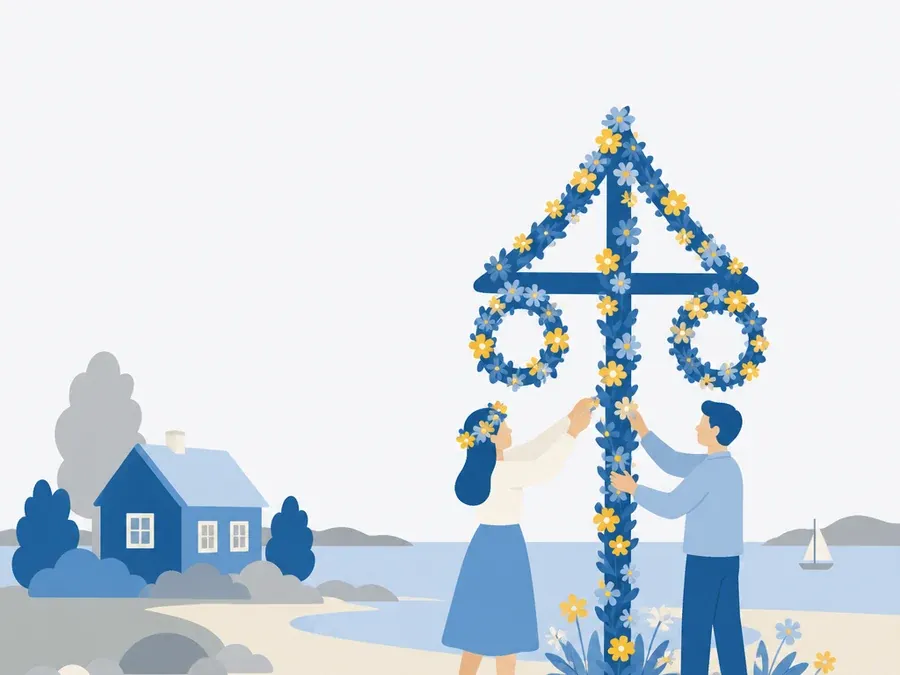
The pole has two names and both are right. Midsommarstång is the plain one, majstång the older one, and which you hear depends mostly on where in the country you are standing. It is a wooden cross with two rings hanging from the arms, dressed in leaves and flowers picked that morning, and raising it is a job several people do together with ropes while somebody else says it is not straight. Turning up early enough to help dress it is the cheapest way to stop being a spectator.
Then people dance around it in a ring, holding hands. Not a folk group in costume, not a display put on for anybody: whoever is there. Adults do it. Adults who have been doing it since they were four do it, next to their own children, and they do it straight. The best known of the dances is Små grodorna, the little frogs, and it involves hopping. If you have decided in advance that this part is not for you, you will spend it standing alone at the edge of a field while everybody else hops, which is its own kind of conspicuous.
Nobody expects you to know the steps and nobody is watching you. Someone calls out what comes next, everyone is half a beat behind, and the same songs come round several times so the second attempt is already better. Rain changes nothing, and the joke made every single year is that it always rains at Midsommar. Wreaths get bound from whatever is growing nearby and worn by adults as readily as by children, and there is usually somebody at a table who will show you how.
| In Swedish | What it means | When you use it |
|---|---|---|
| Ska vi hjälpa till att klä majstången? | Shall we help dress the maypole? | In the morning or just after you arrive. Klä is the verb used for it, the same verb as dressing a person. |
| Jag vet inte hur man gör. | I don't know how it goes. | Said once, out loud, before the ring starts. Somebody will put you between two people who do know. |
| Gör som jag! | Do what I do! | The reply you get. That is the entire instruction and it is enough. |
| Vad heter den här leken? | What's this one called? | Between songs. En lek is a game, and the ring dances are called lekar rather than dances. |
| Vill du binda en krans? | Do you want to make a flower crown? | At the table where the flowers are. Binda is the verb, and nobody is judging the result. |
| Det regnar, men vi dansar ändå. | It's raining, but we're dancing anyway. | Said most years, with some satisfaction. |
| Alla är med. | Everyone joins in. | The answer when you ask who dances. Vara med is to take part. |
The table is cold, and it all arrives at once
Everything goes on the table at the same time and you serve yourself. There is no starter and no main course, and no plate is brought to you. Sill, pickled herring, is the fixed point of the meal. It turns up in several small jars or bowls, and those are different marinades of the same fish rather than different fish: senapssill is the mustard one, inlagd sill the vinegar and onion one, and most tables carry three or four sorts. You take a little of one, eat it, talk, then go back for another.
Around it: färskpotatis, the first new potatoes of the year, boiled and served warm with dill. Gräddfil, a soured cream, spooned over both the herring and the potatoes. Knäckebröd, the hard crispbread, with butter and cheese. Very often cured or smoked salmon, eggs, an omelette or a pie. It is a spread of small salty things rather than a dish, and it lasts a long time because the eating and the talking take turns.
Dessert is strawberries. Jordgubbar, in a bowl with cream, or on a cake with cream between the layers. The first Swedish strawberries of the year land right about now, which is most of the reason they matter as much as they do. If you have been asked to bring something and you have no idea what, this is the safe answer.
One sentence outranks all the vocabulary above. Tack för maten, thanks for the food, is said to whoever cooked, at the table, by everyone including the children. It is not decorative politeness that a foreigner can skip, and the pause where it belongs is audible if it goes missing. You say it again at the door on the way out.
| In Swedish | What it means | When you use it |
|---|---|---|
| Vad gott det ser ut! | That looks good! | As the table is being laid, and it is the easiest thing to say in the first ten minutes. |
| Kan du skicka potatisen? | Can you pass the potatoes? | Across the table. Skicka is the verb for passing something at a meal. |
| Ja tack, gärna lite till. | Yes please, I'd like a bit more. | When you are offered a second round. Gärna carries the whole yes. |
| Nej tack, jag är mätt. | No thanks, I'm full. | Mätt is full in the pleasant sense, and it is the ordinary way to stop. |
| Vem har gjort den här? | Who made this one? | Better than a compliment, because somebody at the table did make it and will say so. |
| Jag äter inte fisk. | I don't eat fish. | Say it when you accept the invitation, not at the table. Herring is the centre of the meal, so the host will want the warning. |
| Tack för maten! | Thanks for the food! | To whoever cooked, at the end of the meal, and again at the door. Everyone says it. |
Snaps, the songs, and how to pass on it
Small glasses appear at some point during the meal, and a song is sung before anybody drinks. That is what a snapsvisa is: a short song performed at the table, sitting or standing, in front of a skål. Helan går is the best known by a distance and it is usually the one that starts things off, because everybody already knows it. Printed sheets get handed round at a lot of tables so that people can join in with the ones they do not know.
You can be completely inside all of this and drink nothing. The singing is the part everyone does. Skål is said with whatever is in your hand, and a glass of water rises exactly the same way. Ingen snaps för mig, tack is a whole sentence and it closes the subject without any discussion attached to it. Jag kör, I'm driving, is the other one, and it gets said several times at any table where people came by car.
Nobody is keeping score, and no reason is required. If you would rather not give one, do not. Nej tack on its own is a complete answer, and saying it a second time is not rude. The point of the evening is the table itself, not what is in the glasses.
| In Swedish | What it means | When you use it |
|---|---|---|
| Skål! | Cheers! | The toast. It is said with whatever you are holding, and it says nothing about what is in the glass. |
| Ingen snaps för mig, tack. | No snaps for me, thanks. | As the small glasses are being filled. Complete, ordinary, and it needs nothing after it. |
| Jag tar något alkoholfritt. | I'll have something non-alcoholic. | When you are asked what you want. Alkoholfritt is the standard word on menus and in shops. |
| Jag dricker inte alkohol. | I don't drink alcohol. | The plainest version. Nobody follows it up. |
| Jag kör. | I'm driving. | Two words, and you will hear them from other guests too. |
| Kan jag få lite vatten? | Could I have some water? | At any point. Vatten is on every one of these tables. |
| Vad är det för sång? | What song is that? | When one starts and you have no idea what is happening. Someone will pass you the sheet. |
What nobody tells a guest
You do not arrive empty-handed, and you ask rather than guess. Vad kan jag ta med? gets a literal answer here: dessert, bread, strawberries, something to drink. Take the answer at face value and bring that. Turning up with the same thing as three other guests bothers nobody. Bringing nothing is noticed, quietly, and never mentioned.
Shoes come off inside the door when it is somebody's home, and the rest of the doorway is the same set of codes that applies to any Swedish home. At a summer place with the party outside, the hallway will tell you what is expected: look at what is on the floor. Offering to help is a real offer and it often gets taken up, which is good news, since carrying chairs out and cutting bread is a much easier way to spend the first half hour than making conversation.
Invitations often come late, sometimes within the same week, and that is not an afterthought about you. Who is going where, whose house is free and how many fit in a car all take time to settle. So say early and plainly that you have nothing planned, and say it to more than one person. Invitations here tend to attach themselves to something already happening, and Midsommar is the clearest example of that in the whole calendar.
Leaving has a shape too. You say tack för maten again to whoever cooked, you carry something into the kitchen, and you say tack för idag at the door. The next time you see those people, which might be three weeks later, you say tack för senast. That last one is noticed far more by its absence than by its presence.
| In Swedish | What it means | When you use it |
|---|---|---|
| Vad kan jag ta med? | What can I bring? | Said the moment you accept. The answer is meant literally, so write it down. |
| Ska jag ta med något att dricka? | Should I bring something to drink? | The narrower question, when the first answer was inget, nothing. |
| Vad kul, tack! Jag kommer gärna. | How lovely, thanks! I'd love to come. | Accepting. Kul is the word people use for this, and gärna does the work of gladly. |
| Hur dags börjar det? | What time does it start? | Ask it. Early afternoon means very different hours to different families. |
| Kan jag hjälpa till med något? | Can I help with anything? | On arrival and again before the meal. Hjälpa till is the phrasal form, and the answer is often yes. |
| Var kan jag ställa den här? | Where should I put this? | Holding whatever you brought, in the doorway. |
| Tack för idag! | Thanks for today! | At the door as you leave, to the people whose house it is. |
| Tack för senast! | Thanks for the last time! | The next time you see them, days or weeks later. Not saying it is the thing that registers. |
If you have nowhere to go this year
Spending your first Midsommar without an invitation is ordinary, and it is not a verdict on you. There is a public version of the day and it is genuinely open. Friluftsmuseer, open-air museums, raise their own pole with music and dancing, and the crowd at them is families rather than tourists. A hembygdsgård, the local heritage association's grounds, does a smaller version of the same thing in a lot of places, and many parks have a pole with times printed by the kommun. You turn up, you pay a small entry or nothing at all, and you are in the ring inside twenty minutes.
The rest of the day belongs to being outside. The right of public access and where exactly it stops is what makes a swim from a shore or a meal on unfenced land unremarkable here, and it is worth reading before you spread a blanket somewhere that turns out to be somebody's garden.
Then ask. In the first week of June, ask two colleagues what they are doing, and say what you are doing, which is nothing. This is a day when an answer of nothing at all turns into a seat at a table more often than at any other point in the year, and the Swedish for it is one sentence long.
Start with the unit on Swedish holidays and get the pole, the herring, the toast and tack för maten into your mouth before that Friday comes round. Ten minutes a day is enough to follow what is being said around a long table instead of watching it happen, and the months before an SFI place opens up are the cheapest practice hours you will ever buy.
| In Swedish | What it means | When you use it |
|---|---|---|
| Var kan man fira midsommar här? | Where can you celebrate midsummer around here? | At a library desk, a tourist office or a reception. Man is the impersonal you. |
| Är det öppet för alla? | Is it open to everyone? | About a park or a museum event. The answer is normally ja. |
| Kostar det något? | Does it cost anything? | Worth asking, since some venues charge an entry and others do not. |
| Får man vara med? | Can anyone join in? | Standing beside a ring that is already dancing. The answer is yes, and asking is not required. |
| Det är första gången för mig. | It's my first time. | Says everything at once, and it usually gets you looked after for the next hour. |
| Glad midsommar! | Happy midsummer! | The greeting on the day, to neighbours and strangers alike. Trevlig midsommar works the same. |
| Tack detsamma! | Thanks, you too! | The answer to it. Two words, and you will need them several times that Friday. |
Questions people ask
- What is midsommar in Sweden?
- Midsommar is the Swedish midsummer celebration and the biggest day of the year after Christmas. It is held privately, at homes, summer houses and village grounds, starting in the early afternoon and running into the evening. A pole called a midsommarstång or majstång is raised and dressed with flowers, people dance around it in rings, and a cold meal of pickled herring, new potatoes with dill, soured cream and crispbread is followed by strawberries.
- When is midsommar in Sweden?
- Midsommarafton, Midsummer's Eve, is the Friday that falls between 19 and 25 June, so the date changes every year and has to be looked up for the year you are asking about. Midsommardagen, Midsummer's Day, is the Saturday immediately after it. The celebrating happens on the Friday.
- What do Swedes eat at midsommar?
- Sill, pickled herring, in several marinades: senapssill with mustard, inlagd sill with vinegar and onion, and usually two or three more. Beside it, färskpotatis, the first new potatoes of the year, boiled and served warm with dill, plus gräddfil, knäckebröd, butter, cheese, often salmon and eggs. Dessert is jordgubbar, strawberries, with cream or on a cake. Everything goes on the table at once and people serve themselves.
- What should I bring to a midsommar party?
- Ask the host, using Vad kan jag ta med? The answer is meant literally and is usually dessert, bread, strawberries or something to drink. Bringing nothing is noticed, and bringing the same thing as another guest is not a problem. Say at the same time if there is anything you do not eat, since herring is the centre of the meal.
- Do you have to drink snaps at midsommar?
- No. Snaps and the short songs sung before a toast, snapsvisor, are a custom at the table, and joining in with the singing is the part everyone does. Ingen snaps för mig, tack is a complete sentence that closes the subject, and Jag kör, I'm driving, is heard at most tables. Skål is said with whatever is in your glass.
- Is everything closed on midsommar in Sweden?
- Many shops close early on Midsommarafton or stay shut, and restaurants often run short hours, but it varies by chain, by town and by year, so check the day before rather than assume. Midsommardagen, the Saturday, is one of Sweden's public holidays. Midsommarafton, the Friday, is not, and whether you personally have it off depends on your employer and your collective agreement.
Know someone who has just moved here?