
The short answer
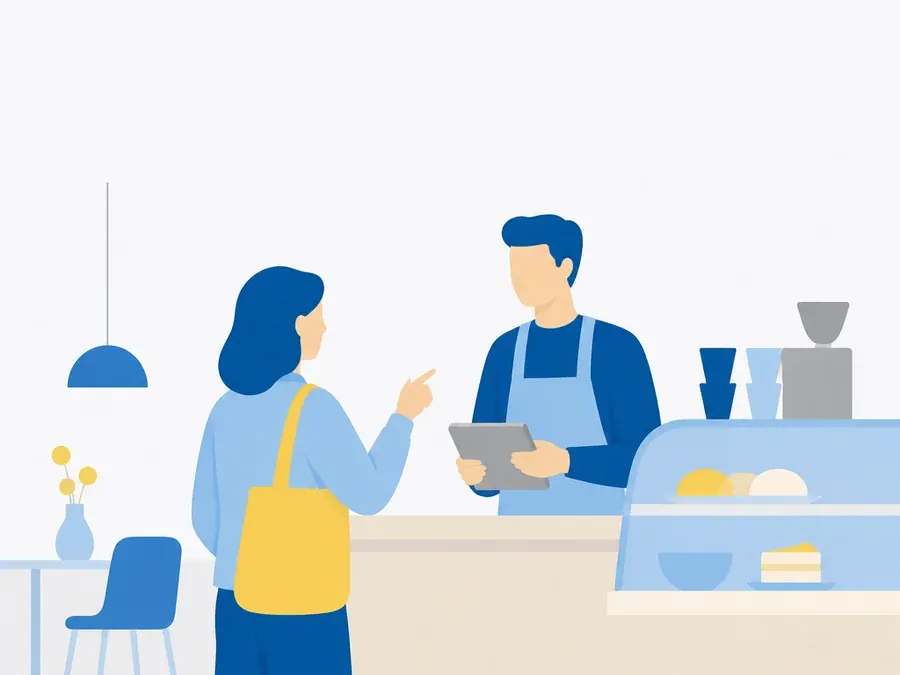
To order food in Swedish at lunch, look for dagens lunch or dagens rätt, the weekday set dish. In many lunch places you order and pay at the counter before you eat, then find your own table. Jag tar dagens, tack means I will take the dish of the day. Vad ingår i dagens? asks what comes with it, because the salad, the bread and the coffee differ from place to place. Jag är allergisk mot nötter means I am allergic to nuts. Evenings run differently: a waiter takes the order at the table, and you ask for the bill with Kan jag få notan, tack.
Lunch has a window, and it closes
Somewhere near the door there is a board with the week on it, headed veckans lunch or lunchmeny, and the line that matters is dagens rätt, often shortened to dagens. It is the weekday set lunch, usually two to four dishes, usually numbered, usually with one of them marked vegetariskt. Weekends are not part of it. A lot of the dishes are husmanskost, the plain Swedish home cooking that shows up on rotation and that every colleague already has an opinion about.
The part that catches new arrivals is that lunch is a window rather than a time of day. It opens late in the morning and shuts in the early afternoon, each place posts its own hours on that same board, and when it shuts, dagens is over. Whole offices move at once, so a place can be empty at half past ten and impossible at noon. Turning up at half past two and asking for the lunch deal gets you a friendly no.
Reading the board is worth the ninety seconds it costs, because the whole vocabulary of the day is written on it: kött is meat, fisk is fish, soppa is soup, sallad is salad. Ordering by number is completely normal and nobody thinks less of you for it. If the board defeats you, one question fixes it, and it is a question Swedes ask each other too.
| In Swedish | What it means | When you use it |
|---|---|---|
| Vad är dagens? | What is today's dish? | At the counter, when the board is unreadable or there is no board. |
| Serverar ni fortfarande lunch? | Are you still serving lunch? | You arrived near the end of the window and cannot tell. |
| Hur länge serverar ni dagens? | How long do you serve the set lunch? | Asked on the way in, before you commit to sitting down. |
| Jag tar nummer två, tack. | I'll take number two, please. | The dishes are numbered on the board. Ordering by number is normal. |
| Jag tar dagens, tack. | I'll take the set lunch, please. | When there is only one dish of the day, or you have already picked it. |
| Finns det något vegetariskt? | Is there anything vegetarian? | There is usually one option, and it is often unlabelled on the board. |
| Vad rekommenderar du? | What do you recommend? | Two dishes, no idea. The answer comes fast and is usually right. |
| Vi är två. | There are two of us. | The first thing said when you walk in with someone. |
You order at the counter, and often pay before you eat
In a large share of lunch places nobody comes to your table at all. You queue at the counter, say what you want, pay right there, and only then sit down. A sign saying beställ vid kassan or betala i kassan is telling you exactly this. If you have ever ordered at a pub bar rather than waiting to be served, the shape is familiar; what is new is that it applies to a hot plated meal in the middle of the day.
After paying you are usually handed something: a numbered stand for the table, a slip, or a buzzer. Cutlery, glasses and water are yours to fetch. So is the tray, en bricka, and at the end of the meal so is clearing it away, which is the detail that most often marks someone out. The sign says duka av själv, and the trolley by the wall is where the tray goes. Nobody will say anything if you walk off leaving it. They will notice.
The Swedish at the counter is short, flat and close to what you already need at the supermarket checkout: a request, tack at the end, and ja tack or nej tack to whatever is offered. Tables are often shared at peak, so the question about a free seat gets asked to you as much as by you.
| In Swedish | What it means | When you use it |
|---|---|---|
| Beställer man i kassan? | Do you order at the counter? | You cannot tell whether to sit or to queue. Asking beats guessing. |
| Ska jag betala nu eller efteråt? | Should I pay now or afterwards? | The rule differs between places, and both answers are common. |
| Ska du äta här eller ta med? | Are you eating in or taking away? | Asked of you at the counter, often shortened to här eller ta med. |
| Jag äter här, tack. | I'm eating in, thanks. | The answer that decides whether you get a plate or a box. |
| Ta med, tack. | Takeaway, please. | The short answer everyone actually gives. |
| Ta ett bordsnummer. | Take a table number. | Said as you pay. You carry the number to your table and the food follows. |
| Är det upptaget? | Is this seat taken? | Shared tables at peak lunch. Nej means sit down. |
| Var lämnar man brickan? | Where do you leave the tray? | You clear your own place. The answer is usually a nod towards a trolley. |
What comes with dagens, and how to ask instead of guessing
A set lunch is rarely just the plate, and what it carries with it is decided by the place, not by any national rule. A salad table, bread and butter, tap water, coffee afterwards: some of these are commonly part of it, none of them always is, and the only reliable move is to ask before you start helping yourself. The question is four words long and no one finds it odd.
When something is included, it is almost never brought to you. The salad sits on a table in the corner under a lid, the crispbread and the butter are beside it, and the water jug is next to the glasses. You get up and fetch it, before the hot plate arrives rather than after. Coffee, where it is part of the deal, is a pot you pour yourself near the exit. Waiting politely at your table for any of this to appear is how a lunch hour disappears.
Two words to keep straight while you are up there. Coffee takes en, water takes ett: en kopp kaffe, ett glas vatten, and nothing inside either word announces which. The en and ett rule sets out how much of that can be predicted, which is less than anyone would like. Tap water is kranvatten, and asking for it is unremarkable.
| In Swedish | What it means | When you use it |
|---|---|---|
| Vad ingår i dagens? | What is included with the set lunch? | Before you start guessing at the salad table. The single most useful lunch question. |
| Ingår kaffe? | Is coffee included? | Asked at the counter, because the answer differs from place to place. |
| Ingår sallad och bröd? | Are salad and bread included? | Same question, the other half of it. |
| Var står salladen? | Where is the salad? | Nobody will show you. It is usually a table against a wall. |
| Får man ta mer sallad? | Can you take more salad? | Second helping at the salad table, when you would rather check first. |
| Kan jag få ett glas vatten? | Can I have a glass of water? | At a table with service. At a counter you fetch it yourself. |
| Finns det kranvatten? | Is there tap water? | Ordinary to ask, and ordinary to be pointed at a jug. |
| Det räcker, tack. | That's enough, thanks. | Someone is serving you and the plate is filling up. |
Saying what you cannot eat
The vocabulary here is small and worth having ready before you are standing in a queue with people behind you. Jag är allergisk mot takes the thing straight after it: nötter for nuts, jordnötter for peanuts, skaldjur for shellfish, ägg for egg, soja, sesam. For something you avoid without an allergy, jag tål inte covers it, as in jag tål inte laktos. To ask about a specific dish, start with the verb: innehåller den här rätten gluten?
You will often be asked first. Har ni några allergier? comes up on its own in table service and sometimes at a counter, and it expects a short answer, not an explanation. What usually happens next is that the person goes and checks: jag ska fråga i köket is the sentence you are listening for. Written menus frequently carry allergen letters or symbols beside each dish, and the heading over them is allergener.
Diet without allergy has its own short forms. Jag äter inte kött is a complete sentence and needs no defence attached to it. Vegetarian and vegan options are both common enough to ask about by name, and asking for a dish without one component, utan grädde, utan ost, is a normal request rather than a favour.
| In Swedish | What it means | When you use it |
|---|---|---|
| Har ni några allergier? | Do you have any allergies? | Asked of you, often before you have opened the menu. |
| Jag är allergisk mot nötter. | I'm allergic to nuts. | The core sentence. Swap in jordnötter, skaldjur, ägg, soja. |
| Jag är allergisk mot skaldjur. | I'm allergic to shellfish. | Worth having ready on any coast, where shellfish turns up in sauces. |
| Jag tål inte laktos. | I can't tolerate lactose. | For what you avoid without calling it an allergy. |
| Innehåller den här rätten gluten? | Does this dish contain gluten? | About one specific dish. Verb first, because it is a yes or no question. |
| Finns det något utan ägg? | Is there anything without egg? | When you would rather be shown the options than rule them out one by one. |
| Kan ni göra den utan grädde? | Can you make it without cream? | A normal request. Den refers back to rätten, the dish. |
| Jag ska fråga i köket. | I'll go and ask in the kitchen. | Said to you. It means wait, not no. |
| Jag äter inte kött. | I don't eat meat. | A full sentence. Nothing is expected after it. |
| Finns det ett veganskt alternativ? | Is there a vegan option? | Common enough to ask for by name almost anywhere. |
Dinner runs on different rules
Middag means the evening meal in Swedish, whatever the middle of the word suggests, and it happens earlier than a lot of arrivals expect. Kitchens close earlier too, so a place still lit at half past nine may have stopped cooking. Booking a table is att boka bord, and for anything busier than a weekday you do it rather than turn up. The staff will ask har ni bokat at the door before anything else.
This is where table service returns and the sequence looks more familiar. Someone seats you or waves you at a free table, menus arrive, and a first pass is made for drinks: vill ni ha något att dricka så länge? The courses are förrätt, huvudrätt and efterrätt. If you carry the American sense of entrée, drop it here, because förrätt is the starter and huvudrätt is the main.
Halfway through the plate someone will come past and ask smakar det bra?, which is asking about the food rather than about you, and ja tack closes it. To get attention across a room, ursäkta plus eye contact does it. Evening service is also the moment a waiter is most likely to hear two Swedish words and answer in fluent English, which is a whole problem of its own: why they switch and what stops it is the fix, and ordering the entire meal in Swedish anyway is the practice.
| In Swedish | What it means | When you use it |
|---|---|---|
| Jag skulle vilja boka ett bord för fyra. | I'd like to book a table for four. | On the phone or at the door. Skulle vilja is the polite ordering verb. |
| Har ni ett ledigt bord? | Do you have a free table? | Walking in without a booking. |
| Har ni bokat? | Have you booked? | Asked of you at the door, before anything else. |
| Har ni bestämt er? | Have you decided? | The waiter returning to take the order. Not yet is inte än. |
| Vill ni ha något att dricka så länge? | Would you like something to drink in the meantime? | The first pass, before food is ordered. |
| Jag skulle vilja ha förrätten och sedan fisken. | I'd like the starter and then the fish. | Ordering in courses. Sedan links them. |
| Smakar det bra? | Is the food good? | Mid-meal. It is about the plate, not about your day. Ja tack ends it. |
| Kan jag få en till, tack? | Can I have another one, please? | Second drink, same as the first. |
| Ursäkta! | Excuse me! | Getting a waiter's attention. Eye contact does most of the work. |
Getting the bill, and the tipping question
The bill is notan, and it comes when you ask for it. Kan jag få notan, tack is the whole request. In plenty of casual places you do not ask at all, you walk up to the counter and pay there, and betalar man i kassan? settles which it is. Keep nota apart from räkning, which is the kind of bill that arrives by post from a company; asking a waiter for your räkning will get you a puzzled second.
Splitting is unremarkable. Var för sig means separately, and the question often comes to you before you raise it: tillsammans eller var för sig? Card terminals are carried to the table and handle several cards without drama, and among friends the leftover half is usually settled afterwards with Swish rather than at the table.
Tipping, dricks, is where confident advice online is worth ignoring. The terminal often shows a tip option, sometimes as buttons and sometimes as a blank field, and choosing nothing is one of the choices it offers. Practice varies between a weekday lunch and a long evening, between one place and the next, and between two Swedes at the same table. Watch what happens around you, decide once, and stop thinking about it.
| In Swedish | What it means | When you use it |
|---|---|---|
| Kan jag få notan, tack? | Can I have the bill, please? | Table service. The bill does not arrive unasked. |
| Kan vi betala var för sig? | Can we pay separately? | Said before the card comes out. Rarely a problem. |
| Tillsammans eller var för sig? | Together or separately? | Asked of you, terminal already in hand. |
| Betalar man i kassan? | Do you pay at the counter? | When nobody seems to be bringing anything and you are ready to leave. |
| Kan jag betala med kort? | Can I pay by card? | Almost always yes. Cash is the exception now. |
| Dricks | Tip | On the terminal screen, above the buttons. Selecting nothing is an option it offers. |
| Det var jättegott, tack. | That was really good, thanks. | On the way out. Warm without being a speech. |
| Tack för maten. | Thanks for the food. | Said to whoever cooked. At a Swedish friend's table it is not optional. |
Five lunches a week is a language course
To make more of the menu readable before you order, review the Swedish food vocabulary guide and the Swedish cooking verbs: together they turn ingredients and preparation into useful clues.
The reason to start here rather than with a phrasebook is arithmetic. You eat lunch every working day, the exchange is under a minute, and it repeats with almost no variation: what you want, eating in or taking away, what is included, where the tray goes. That is four sentences you get to run roughly twenty times a month, in front of someone who is busy and has no interest in grading your endings.
The stakes never rise. Order the wrong dish and you eat the wrong dish. Nothing else in your first year in Sweden gives you that much repetition at that little cost, and the workplace version of it, the lunch and fika hour with colleagues, is the same words with people who already know you.
One practical choice makes it work faster: go to the counter with the sentence already loaded rather than assembling it while the person waits. Jag tar dagens, tack takes a second and a half. Start with the food and drink unit and drill the dish names until the board reads like a board instead of a wall. The months before an SFI place opens up are the cheapest practice hours you will ever get.
Questions people ask
- How do you order food in Swedish?
- Jag tar dagens, tack means I'll take the dish of the day, and Jag skulle vilja ha is the politer opening for anything on a menu. At lunch you often say it at a counter and pay immediately. In the evening a waiter takes it at the table and asks Har ni bestämt er first.
- What does dagens lunch mean?
- It is the weekday set lunch, also written dagens rätt or just dagens. A place offers a small number of dishes, often numbered on a board by the door, served only inside a fixed midday window. When the window closes, dagens stops and you order from the ordinary menu.
- Do you have to tip in Swedish restaurants?
- Dricks is the word for a tip, and the card terminal often offers one as a button or a blank field. Selecting nothing is one of the options it gives you. What people actually do varies by place, by meal and by person, so watching the table next to you tells you more than any rule.
- How do I say I have an allergy in Swedish?
- Jag är allergisk mot, then the thing: nötter for nuts, jordnötter for peanuts, skaldjur for shellfish, ägg for egg. For something you avoid without an allergy, jag tål inte laktos. To ask about one dish, innehåller den här rätten gluten. Menus often list allergener beside each dish.
- How do you ask for the bill in Swedish?
- Kan jag få notan, tack. The bill is notan and it does not arrive until you ask. In casual places you may pay at the counter instead, and betalar man i kassan asks which it is. To split it, kan vi betala var för sig.
Know someone who has just moved here?