The short answer
A game trains one thing well: speed. Recognising a word in a second instead of five is what separates following a conversation from asking people to repeat themselves, and that speed comes from repetition under mild pressure. What a game cannot do is teach a rule you have never met, build a sentence out loud, or give you a level anybody will accept on paper. Use games for ten minutes after a lesson, not instead of one. Svenska App has 19 games, and every one is free to try. Five are free in every round. In the other 14, rounds 1 and 2 are free and round 3 and up come with Plus. Each round opens only after the course has taught what it drills.
What a game can actually teach you
There are two different abilities hiding behind the phrase knowing a word. One is recognition: you see tvättstuga and remember it is the laundry room. The other is retrieval speed: the word arrives in a sentence somebody is still speaking, and you have about a second before the rest of the sentence has gone past you.
Adults learning Swedish almost always have more of the first than the second. That gap is what makes people say they understand Swedish when reading and understand nothing in a shop. A game closes it, because it forces the same decision hundreds of times with a small consequence attached, and that is what turns a word you know into a word you know fast. The mechanism behind that, and the four places it stops working, are in why playing works when a list does not.
The part a game does badly is everything that needs a rule. Sorting en-words from ett-words is useful drill once the gender has been taught and pure guessing before that. Guessing under a clock is practice at guessing, which is why our games open at the level where the course has already explained the thing they ask for. If you want the rule first, the grammar pages are written one rule at a time. It is the same limit a general multi-language course hits with noun gender, described in where a general language app stops with Swedish.
| In Swedish | What it means | When you use it |
|---|---|---|
| Vi spelar! | Let's play. | Said to a child, or to an adult holding a board game box. |
| Vems tur är det? | Whose turn is it? | The phrase that runs every game night in Sweden. |
| Jag fick tio poäng. | I got ten points. | Poäng is both the singular and the plural. |
| En gång till! | One more time. | What you say when the round ended badly and you want another. |
Nine of the games, and what each one drills
Every one of these came from something that goes wrong in real life rather than from a list of vocabulary. There are twenty-nine rounds across the nine. Parachutes, Sound pairs, Fika, The counter and Fishing are free in every round. The departure board, The recycling room, Moving in and The forecast have two free rounds, then Svenska Plus.
If this is your first week, use the shorter route through our Swedish games for beginners. If spoken Swedish is the bottleneck, the listening-games guide orders the same games from visible support to audio only.
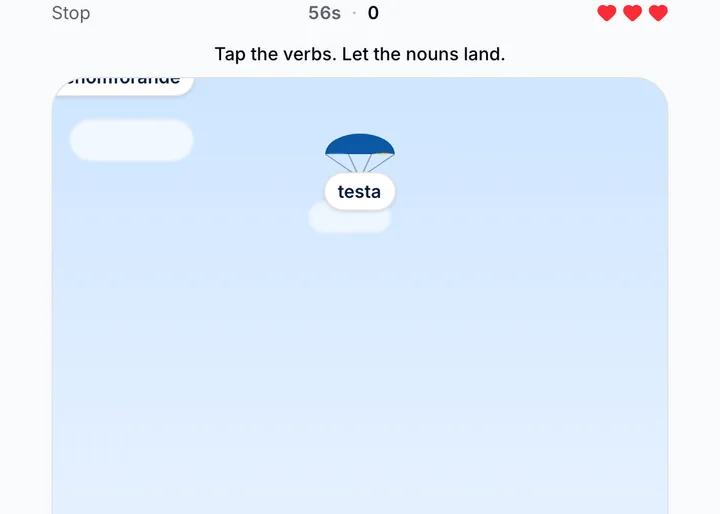
Parachutes. Words come down and you catch a category: the verbs, then the nouns, then the ett-words. It is the fastest drill for word classes, and the ett-round is the only honest way to practise gender once you have been taught it.
The departure board. A station announcement plays, and you find the row it is about. This is the one that pays off first in real life, because a platform change in Swedish is announced once and not repeated.
The recycling room. Things arrive in the soprum and go to the bin they really belong in. Four bins, then six, then the whole room. The vocabulary is the vocabulary of your own building, which is why it sticks. There is a longer article on how to read the bins.
Sound pairs. A memory grid where half the cards say a word and half spell it. It attacks the exact weakness most learners have, which is that Swedish spelling and Swedish sound drift apart at sj-, tj- and the vowels.
Moving in. Boxes come down a ramp and go to the right room. Household vocabulary, and a later round that asks for the gender of the thing in the box.
Fika. Somebody orders at the counter, you build the tray and get the numbers right. Listening to quantities is a separate skill from knowing the numbers, and this is where most people discover that.
The counter. A queue at a service desk, and each person goes to the right window. Skatteverket first, then the agencies, then no labels at all. It drills the vocabulary of Swedish admin, which is the vocabulary that costs you a wasted trip.
The forecast. A forecast is read out, you tap the city on the map and then the weather. The last round removes the map and leaves only the audio.
Fishing. Four fish, four forms of one verb, catch the one being asked for. Present, then preterite, then the strong verbs that do not follow the pattern.
| In Swedish | What it means | When you use it |
|---|---|---|
| Tåget mot Uppsala avgår från spår sju. | The train towards Uppsala departs from platform seven. | The announcement shape the departure board round is built on. |
| Jag tar en kanelbulle och en kaffe, tack. | I'll have a cinnamon bun and a coffee, please. | The order the fika round asks you to assemble. |
| Var kastar man glas? | Where do you throw glass? | In the recycling room, when the bins are unlabelled. |
| Vilken lucka ska jag gå till? | Which window should I go to? | At a counter with several desks and no queue system. |
Why a game can be shut, and what opens it
Games unlock by level rather than by how much you have played, and the levels run A1, A1+, A2, A2+, B1. Parachutes, the departure board, the recycling room, sound pairs, moving in and fika are open from the first day. The counter and the forecast wait for A1+, fishing waits for A1+ for the present tense and A2 for the past.
The rule inside each game is the same: a round opens once the course has taught what it asks for. The en and ett round of Parachutes waits for A2 for that reason, and nothing that has been unlocked is ever taken away, including after a new placement test puts you somewhere else.
If you have Swedish already and do not want to walk through units you do not need, the placement test takes two minutes and opens what matches.
The leaderboard, and the part that pays XP
Each game and each round has its own public board. You can read it without an account, which is deliberate: a board you cannot see is not a reason to come back.
Saving a score needs an account, because a score has to belong to somebody. XP goes to the top three of a board only, 140, 80 and 45, and it is paid once for the best position you have held. Playing forty rounds pays nothing on its own. That is on purpose: XP measures progress in the course, and paying it per round would turn the course into a clicking contest.
Every round is generated fresh, so the answers cannot be memorised. Two players opening the same game get different words in a different order.
The games Swedes actually grew up with
At some point you will be at a kitchen table where a box comes out, and the language of that table is worth having in advance.
Fia med knuff is the Swedish version of ludo, the game every Swedish child has played, and knuff means the shove you give a piece that is sitting where you want to be. Alfapet is the Swedish crossword game, which is brutal and excellent for a learner because it forces you to think about which letters actually combine in Swedish. Kubb is the lawn game with wooden blocks that appears at every summer gathering. Vem vet mest? is the long-running quiz show, and watching it is free listening practice with a scoreboard.
None of these teaches you Swedish on its own. What they do is put you in a room where Swedish is being spoken about something concrete, with your turn arriving every two minutes, which is a better place to be than most classrooms. The trick is saying the sentence that stops everybody switching to English, and there is a whole article on that.
| In Swedish | What it means | When you use it |
|---|---|---|
| Får jag vara med? | Can I join in? | The sentence that gets you into any game, said by children and adults alike. |
| Kan du förklara reglerna? | Can you explain the rules? | Ask before the first turn, not during it. |
| Jag förstod inte, kan du ta det igen? | I didn't understand, can you go through it again? | Better than nodding and losing the next ten minutes. |
| Du vann. Grattis! | You won. Congratulations! | Grattis is the whole sentence most of the time. |
What games will not do for you
They will not make you speak. Producing a sentence out loud, with a person waiting, is a separate skill and it is the one that decides whether you use Swedish at work. Games build the raw material for it and stop there, which is one of the reasons a class and self-study are not competing for the same job.
They will not give you a level anybody accepts. No app produces documentation. That comes from SFI, from a school, or from an external exam, and it is worth knowing how SFI and self-study fit together before you decide what to sign up for.
And they will not survive being your only method. Ten minutes of games after a lesson is a multiplier. Ten minutes of games instead of the lesson is a pleasant way to stay where you are, and what ten minutes a day genuinely buys sets the ceiling on both.
Questions people ask
- Do games actually work for learning Swedish?
- For one part of it, yes. A game drills retrieval speed, which is the difference between recognising a word on a page and catching it in a sentence somebody is still speaking. That is a real bottleneck for adults and games fix it faster than reading does. What a game cannot do is teach you a rule you have not met, or make you produce a sentence out loud, so it belongs beside lessons rather than in place of them.
- Are the games on Svenska App free?
- All 19 are free to try. Five are free in every round: Parachutes, Sound pairs, Fika, The counter and Fishing. In the other 14, rounds 1 and 2 are free and round 3 and up come with Svenska Plus. Course-level locks still apply so a game never tests a rule before it has been taught.
- Why is a game locked?
- Because the course has not taught the thing it drills yet. Sorting en-words from ett-words before the gender is introduced is guessing, and a game that rewards guessing teaches guessing. Each locked card says which level opens it, the levels run A1 to B1, and anything already unlocked stays unlocked.
- Which game should a complete beginner start with?
- Parachutes, catching the verbs. It needs only the difference between a verb and a noun, it has no timer, and the difficulty rises slowly as you survive. Sound pairs is the other good first choice if your problem is that written Swedish and spoken Swedish do not sound like the same language yet.
- Do I earn XP from playing?
- Only on the podium. The top three of each board earn 140, 80 and 45 XP, paid once for the best position you have held. Playing more rounds does not pay by itself, because XP is meant to measure progress through the course rather than time spent on a leaderboard.
- Can children use them?
- They are built for adults learning Swedish, and the vocabulary is the vocabulary of moving to Sweden, recycling rooms and service counters rather than of a classroom. Children who read can play them, and the departure board and sound pairs work well for a family learning together, but the fit is best for someone who has to use Swedish this week.
Know someone who has just moved here?