
The short answer
Utvecklingssamtal is the individual meeting a Swedish teacher holds with a pupil and a parent, usually once or twice a term, to talk through how the child is doing academically and socially. It is separate from föräldramöte, the larger group meeting for all parents in a class, which covers logistics and school-wide news rather than one child. Before year 6, Swedish schools do not give grades, so the conversation is qualitative: strengths, what needs work, and how the child is settling in socially. Bringing a notepad, asking for an interpreter, tolk, in advance if needed, and preparing two or three questions turns a fifteen-minute slot from something to survive into something useful.
Two meetings, and they are not the same thing
Two different letters come home from a Swedish school, and they get confused constantly by newcomers. Föräldramöte is the group meeting, all the parents in a class in one room, usually early in the term, covering schedules, trips, and whatever the teacher wants the whole group to know. Nobody talks about your child specifically.
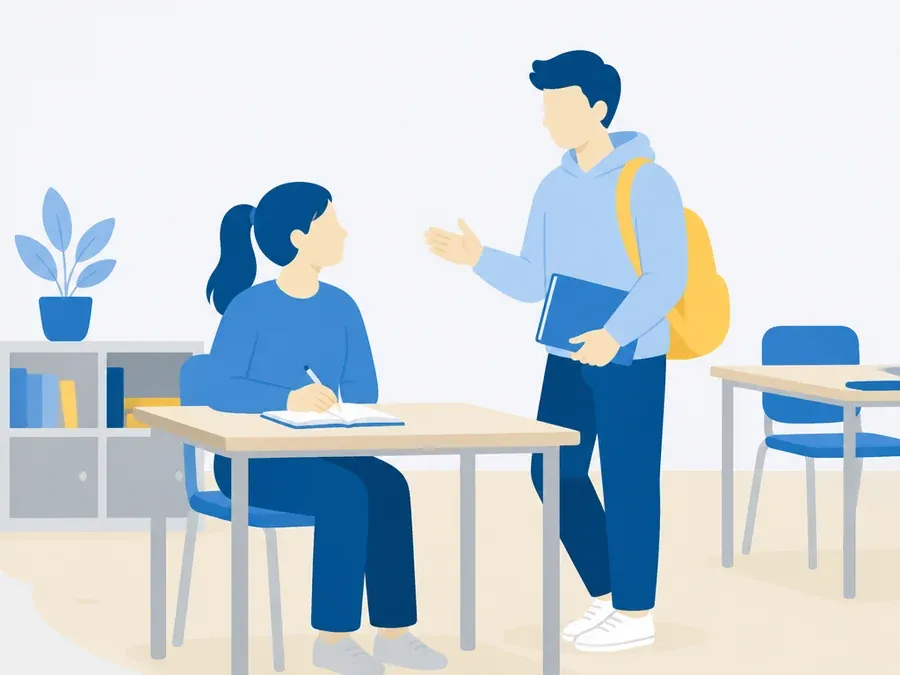
Utvecklingssamtal is the other one, and it is about your child alone: a fifteen to thirty minute slot, usually you, the teacher, and often the child too, sitting together once or sometimes twice a term. The word breaks down cleanly once you know it: utveckling is development, samtal is a conversation, so it is literally a development conversation, not an evaluation or a hearing.
Knowing which one you are booked into changes how you prepare. A föräldramöte needs nothing from you beyond showing up. An utvecklingssamtal is worth five minutes of thought beforehand, because it is the one conversation each term built entirely around your child.
Who is actually in the room
The teacher who holds the meeting is usually your child's mentor, the one member of staff who follows them across subjects and keeps the overall picture. Some schools still use the older word, klassföreståndare, for the same role. In the first years of grundskolan it is often simply the teacher who takes most of the lessons anyway, so the label matters less than knowing who to write to afterwards. Sometimes a second teacher joins for a subject they teach, or someone from fritids, the after-school club, comes in for the part about the hours between the last lesson and pick-up.
If your reference point is a parents' evening, adjust it. There is no hall, no queue of parents on small chairs, no bell after four minutes. An utvecklingssamtal is a booked slot in a room with the door shut, and the family after you has a slot of their own, so nothing is said within earshot of anyone else. That closed door is also why the meeting can go somewhere a parents' evening never does. There is room for one awkward question, and asking it does not hold up a line.
Parents whose child came up through a Swedish förskola have met a version of this before, since preschools usually hold their own utvecklingssamtal on much the same cycle. The step that comes before it is a different animal entirely, and applying for a förskola place runs on queue dates rather than conversations. What carries over is the format: a slot you book yourself, a short talk about one child, and a teacher who expects you to say something back.
| In Swedish | What it means | When you use it |
|---|---|---|
| Vem är mitt barns mentor? | Who is my child's mentor? | The mentor follows your child across subjects and usually holds the meeting. |
| en klassföreståndare | a class teacher | The older word for the same role. Some schools and plenty of older Swedes still use it. |
| Vem mer är med på samtalet? | Who else is coming to the meeting? | Worth asking when you book, so nobody in the room is a surprise. |
| Ska mitt barn vara med hela tiden? | Is my child there for the whole meeting? | Answers change by school and by year group, so ask rather than assume. |
| Hur lång tid har vi? | How long do we have? | Ask it in the first minute. It tells you how many questions actually fit. |
| ett fritidshem | an after-school club | Usually shortened to fritids. Its staff sometimes join part of the conversation. |
What actually gets discussed
Before year 6, Swedish schools do not give grades, betyg, so an utvecklingssamtal before that point is qualitative rather than a report card conversation: how your child is doing in specific subjects, how they interact with classmates, whether they seem settled or are struggling with something specific. It can feel unfamiliar if you come from a system built around numbers and rankings, but the absence of a grade does not mean the absence of a clear picture.
The teacher usually opens with an overview, then leaves room for you to add what you are seeing at home that they cannot see at school: sleep, mood after school, how homework goes, anything your child has mentioned about friendships. This is the part newcomers most often under-use, staying quiet because the vocabulary feels too far out of reach, when a short honest sentence in English translated in your head into a slower Swedish sentence works fine.
If your child is present, which is common from early primary years onward, part of the meeting is often addressed directly to them: what they enjoyed this term, what felt hard. It is worth preparing your child for that a little, so the question does not land as a surprise in the room.
Some of it is written down, and those words are easier to meet in advance than in the room. Ett omdöme is an assessment of how the child is doing in a subject, and it is a sentence rather than a mark. En individuell utvecklingsplan, almost always shortened to IUP, is the document that records what the child is working towards next. Ett mål is a goal. Ask which of these exist for your child and where you can read them, because they usually sit inside the school's platform rather than coming home in a school bag.
| In Swedish | What it means | When you use it |
|---|---|---|
| ett utvecklingssamtal | a development conversation | The individual meeting about your child, usually once or twice a term. |
| ett omdöme | a written assessment | A sentence about how your child is doing in a subject, not a mark. Plural: omdömen. |
| Vad är målet till nästa samtal? | What is the goal before the next meeting? | The question that gives the fifteen minutes something to lead to. |
| Var kan jag läsa det? | Where can I read that? | When a document is mentioned that you have never seen. |
| ett föräldramöte | a parents' meeting | The group meeting for the whole class. Not about your child specifically. |
| Hur går det för honom/henne i skolan? | How is he/she doing at school? | A natural opening question if the teacher has not already covered it. |
| Hemma har vi märkt att... | At home we've noticed that... | The bridge into telling the teacher something they cannot see themselves. |
| Trivs hon/han med de andra barnen? | Is she/he getting on with the other children? | Worth asking directly if it has not come up. |
The questions worth asking back
An utvecklingssamtal is a conversation, not a report you sit through, and Swedish teachers generally expect questions rather than a silent nod. Two or three prepared in advance make the fifteen minutes work harder: what your child is good at that might not show up on paper, what you can do at home to support a specific subject, and whether anything about settling in as a newcomer has come up in class.
If English feels safer for a nuanced point, most Swedish teachers switch without hesitation, and that is a fine choice for the substance of the conversation. The phrases below matter less for getting every detail across than for opening the exchange in Swedish, which tends to shift the whole tone of the meeting toward warmer and more patient on the teacher's side.
Leave with one thing rather than five. A meeting that produces a single concrete change at home, ten minutes of reading in Swedish after dinner or a different slot for homework, beats one that produced a long list nobody ever looks at again. Write that one thing at the top of your page before you stand up, and say it out loud to the teacher, so the person who sees your child every day knows what you took away and can tell you if you took away the wrong thing.
When a sentence about your child goes past you
The sentence that trips people up is rarely the difficult vocabulary. It is the ordinary one carrying a judgement: that your child is quiet in group work, that something is not quite settling, that a subject needs more time. It arrives at normal speed, you catch most of it, and the instinct is to nod and reassemble it in the car afterwards. That is the version people regret, because the piece that went missing is usually the piece that mattered.
Two questions do nearly all of the repair work. Kan du ge ett exempel turns a general remark into a scene you can picture, and a scene is far easier to follow in a second language than an abstraction. Vad betyder det i praktiken asks what it looks like from where you are sitting: more reading at home, a word with someone at school, or nothing at all. Teachers answer both readily, because both beat a parent who agreed to something they had not followed.
Then say it back. Jag vill vara säker på att jag förstod rätt, followed by your own version in whatever Swedish you have, hands the teacher a sentence to correct instead of one to repeat at the same speed as the first time. It is the most useful move in the whole quarter of an hour, and it works exactly as well once the conversation has slipped into English.
| In Swedish | What it means | When you use it |
|---|---|---|
| Hur menar du? | What do you mean by that? | Three words, entirely normal, and they ask for the thinking behind a remark. |
| Kan du ge ett exempel? | Could you give an example? | When a comment about your child is too abstract to picture. |
| Vad betyder det i praktiken? | What does that mean in practice? | Turns an assessment into something you can actually act on. |
| Jag vill vara säker på att jag förstod rätt. | I want to be sure I understood correctly. | Then give your version back. The teacher corrects it rather than repeating theirs. |
| Är det något vi ska jobba med hemma? | Is that something we should work on at home? | The follow-up that converts a worry into a plan. |
| Ska jag vara orolig? | Should I be worried? | Blunt, and a Swedish teacher will answer it straight. |
If Swedish is not enough on the day
You can ask for an interpreter, en tolk, for an utvecklingssamtal, and the school will tell you what it is able to arrange. Ask early, when you book the slot or the week before rather than on the day, since a tolk has to be found and booked by someone. It is a completely ordinary request and not an admission of anything. Waiting until you are in the room and struggling is the version to avoid; asking a week ahead is the version that works.
The request travels better in writing than on a doorstep, partly because you can take your time over it and partly because it leaves a trace. A Swedish email is short by design: Hej, one sentence saying why you are writing, one question, Mvh and your name. The rest of what goes between Hej and Mvh is the same small set of lines whether you are writing to a teacher, a landlord or an agency.
A shorter fallback if an interpreter was not arranged: bring a translated list of two or three questions on your phone, and ask the teacher to write down anything important rather than only saying it aloud. Most teachers will happily jot a sentence on paper if it means the message actually lands.
| In Swedish | What it means | When you use it |
|---|---|---|
| Skulle det gå att boka en tolk till mötet? | Would it be possible to book an interpreter for the meeting? | Said or emailed when you book the slot, not on the day itself. |
| Kan du skriva ner det viktigaste? | Could you write down the most important points? | When a sentence goes by too fast to catch fully. |
| Förlåt, kan du förklara det på ett annat sätt? | Sorry, could you explain that a different way? | Better than nodding through a sentence you did not follow. |
Booking it, and arriving prepared
The booking usually happens through the school's digital platform, often Unikum, Infomentor or Schoolsoft depending on the kommun, with a list of open time slots you pick from rather than a fixed appointment assigned to you. It is worth checking that platform in the first weeks after your child starts, since that is also where absence reports and homework often live. If none of the times work, finns det någon annan tid asks for another one, and it is a normal question rather than a favour.
That platform is not the same thing as the digital mailbox where official Swedish post now arrives. Messages from the school stay inside the platform and do not turn up there, so checking one does not cover the other. Two logins, two habits, and the term when you discover that is usually the term you missed something.
Arrive with two things: a notepad, since a written note survives a nervous fifteen minutes better than memory does, and two or three questions decided in advance. The meeting is short by design, built to happen once or twice a term rather than to cover everything at once, so the goal is a clear read on one or two things, not a full report.
Questions people ask
- What is an utvecklingssamtal in Swedish schools?
- It is the individual meeting a teacher holds with a pupil and a parent, usually once or twice a term, to discuss how the child is doing academically and socially. The word means development conversation. It is separate from föräldramöte, the group meeting for the whole class.
- Do Swedish schools give grades before secondary school?
- No. Grades, betyg, start in year 6. Before that, an utvecklingssamtal is a qualitative conversation about strengths, areas to work on and social wellbeing rather than a report built around marks or rankings.
- Can I get an interpreter for a parent-teacher meeting in Sweden?
- You can ask, and the school will tell you what it is able to arrange. Ask when you book the utvecklingssamtal, ideally a week ahead, since finding a tolk on the day itself is often too late. It is a normal, unremarkable request in a Swedish school.
- Is my child present at an utvecklingssamtal?
- Often, especially from early primary years onward. Part of the conversation is usually addressed directly to the child, so it is worth preparing them briefly for that beforehand so the question does not come as a surprise.
Know someone who has just moved here?